
Water Supply Pipes: Responsibility and Leaks
When a pipe springs a leak, the question of responsibility immediately springs to mind. According to Ofwat, the water sector’s economic regulator, around 20% of the UK water supply is lost to leakages. Insurers Direct Line quote that 35% of UK adults have had to deal with a leak in the last 12 months. So, from time to time all households will likely experience an ‘escape of water’ in one form or another.
With regards to leaky appliances or household pipes, the homeowner is undoubtedly responsible. But in the case of water supply pipes, which in some cases extend far beyond the legal boundary of the property, many homeowners are unaware of their legal responsibility to maintain and repair this section of pipework. A suspected leak in a supply pipe might be the first time a homeowner becomes aware of this responsibility, at which point the threat of an inflated water bill, a ‘Waste of Water Notice’ and costly repairs are looming.
It isn’t always easy to figure out which section of pipework you are responsible for as a homeowner, and which pipes and fittings on the supply network are under the care of the water company. The following article will look at who is responsible for different types of pipes, the legislation surrounding this and what to do if you are issued with a ‘Waste of Water’ Notice.

Who is responsible for which pipes?
Water companies and homeowner(s) are responsible for different parts of the water supply network. This network consists of a variety of pipes: mains, service, communication and supply pipes.
According to Ofwat, mains, service and communication pipes are owned by water companies, who are therefore responsible for maintaining them. This is usually the case even if these pipes are laid under private land (as opposed to highways or footpaths). Fittings on mains, service and communication pipes - such as water meters and stop taps - are owned and maintained by the water company, too.
A stop tap connects the communication or service pipe to a property’s supply pipe. Supply pipes are the responsibility of the property owner(s); in the case of single supply pipes, the responsibility falls solely on the owner(s) of the single property it supplies. For shared supply pipes, responsibility is shared between the multiple property owners supplied. Shared supplies are usually easy to spot, as there will be a stop tap outside each property.
In many cases, the water supply pipe will start at, or close to, the property boundary. In other cases, the supply pipe extends some distance from the property boundary until it is connected to the communication or service pipe near a main road, street or footpath. In these cases, the supply pipe might be laid under someone else’s land.
Ofwat makes it clear that there are special cases, and the question of responsibility depends on the particular set up of the water supply to a property or properties. The water company supplying the property should be able to advise on these cases, or there may be specific information in the property’s Title Deeds regarding the water supply.
Leaky supply pipes
According to the Chartered Institute of Water and Environmental Management, Ofwat data points to some 45 litres per household per day being wasted from leaky supply pipes- pipes which are the responsibility of the homeowner(s).
As a homeowner, you may suspect or realise that you have a leak in your supply pipe in one of many ways. You might see very obvious signs: water pooling on your lawn, boggy patches in your garden during dry weather, clanging pipes, or loss of water pressure for example. However, your suspicions might only arise when hit by an unexpectedly large water bill. In some cases, a water company might get in touch to flag unusually high usage levels before billing and use this as a basis of investigating a leak.
Common household leaks
If your water usage has sky-rocketed, don’t rush to assume that you have a leaky supply pipe. Plumbing, Heating and Air Movement Magazine (2023) suggest internal leaks from appliances or internal pipework can cost households an extra £308 per year on their water bill. Conducting a series of simple checks around your property will rule out these leaks or other reasons for inflated water usage, which can be significantly easier and cheaper to fix than a leaky supply pipe. These include:
- Running toilets. According to Wessex Water, a running toilet can add around £50 to your monthly bill (wasting 400 litres a day), and it can be tricky to spot. A ‘toilet paper test’ is a good indicator: after your toilet has been unused for a few hours, place a scrap of toilet paper below the rim, on the side of the toilet bowl; refrain from flushing the toilet for a few hours, and check to see if the paper is still dry; if it is wet or ripped, you have leak. Leak detection tablets are also available, which show whether dyed water is leaking from the cistern into the toilet bowl; these can be purchased from around £0.99.
- Similarly, double check for any dripping or leaking taps, including any outdoor taps. According to Watersafe, a tap leaking at a rate of 1 drip per second can waste 5,500 litres of water per year.
- Check the ball valve in any loft water tanks (this shouldn’t be running constantly).
- Look for malfunctioning appliances (washing machines, water softeners etc.). Check behind and under these appliances, even if they appear to be working well, in case there are signs of water escape.
- If you have new appliances that might use more water, calculate whether this could account for the increased usage reported by the water company.
If the above can be ruled out, the water company should then investigate the source of the problem and locate the leak. All water companies should have a policy for dealing with potential leaks. With any luck, your account billing will be put on hold whilst this investigation is carried out.
The water company’s investigation will involve checking the water meter (if applicable). By running water in the house and monitoring the meter, then monitoring the meter whilst absolutely no water is being used in the house, they can determine whether the meter is working correctly and also whether the leak is likely in/on your property, or in the supply pipe. If a supply pipe is likely to be leaking, the homeowner is then responsible for locating and repairing the leak.
Repairs
If a supply pipe is found to be leaking, you as homeowner are solely or jointly (with other homeowners who share the supply) responsible for locating the leaks, the repair and paying for wasted water. However, most water companies will apply a leakage allowance to your account balance if the leak was identified and repaired in good time. Moreover, according to Ofwat most water companies will locate and repair a leak on a supply pipe if it is the first leak. For serial offenders, a cost is likely to be incurred in terms of locating and repairing the leak or replacing the pipe. For very old pipes or those that have been badly damaged, corroded or are disintegrating, some water companies may offer a grant or subsidy towards the cost of replacing the pipe entirely. Each water company will have their own policies on this, so it is important to consult with them throughout.
Legislation
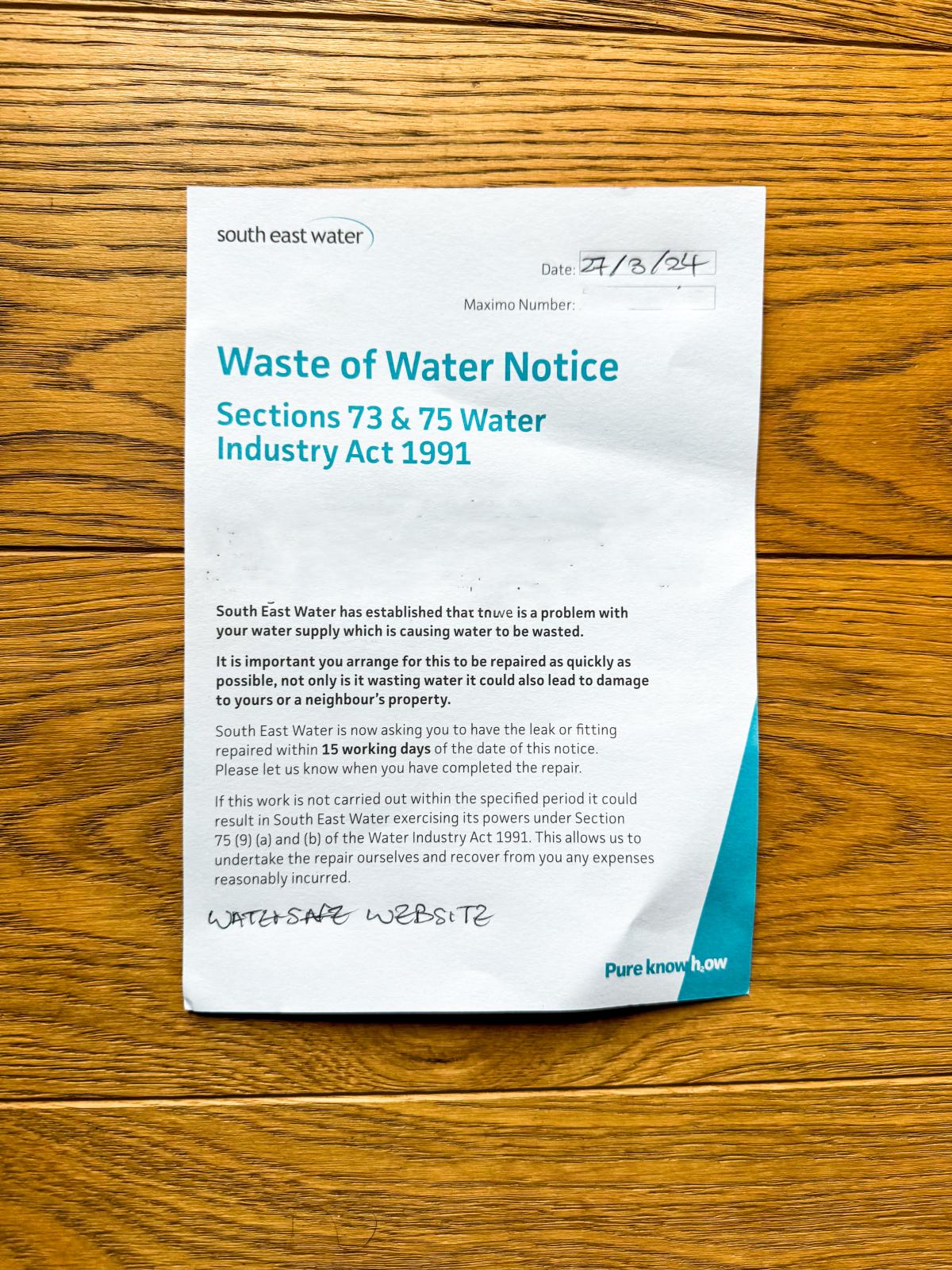
Homeowners with a leaky water supply pipe, or other leak in their property, can expect to be served a Waste of Water Notice, under Sections 73 and 75 of the Water Industry Act (1991). This notice gives the homeowner 15 working days to carry out the repair. You will be asked for a meter reading from the day of the repair, which will help in calculating a leakage allowance.
If the repair can’t be completed within that timeframe, you can contact your water company and explain any extenuating circumstances. If you fail to carry out the repair within that timeframe with no good reason or communication with the water company, or if the situation is urgent, the water company can carry out the repair themselves and charge you for this. They can even disconnect the supply if a property is unoccupied in an emergency situation.
Some home insurance policies might include cover for repairs to a water supply pipe, others specifically exclude external pipework or pipework. Many insurance companies offer specific cover just for water supply pipes. It is worth checking your home insurance policy and what this covers, as you may be able to claim on this if faced with a hefty repair bill.
Understanding your responsibility
For some homeowners, the risk of a water supply pipe leaking and requiring extensive and expensive repair is minimal. For example, if the responsibility is shared, or the pipe itself is relatively short, easily accessed (not under concrete) or has been recently laid (and therefore in good condition). In other cases, a water supply pipe might extend some distance from your property boundary, under privately owned land; it might be more than 40 or 50 years old, in which case it could be prone to leaks, corrosion or other damage. It is important to be aware that you may be required to fork out for the repair and maintenance of this pipework, and that the cost may be considerable for repeated leaks or ultimately replacing the pipe.
This is particularly pertinent if you are considering buying a property with the above concerns. Potential buyers might want to ask: how old is the supply pipe? Where is the stop tap and/or water meter? How far is this from the property boundary and whose land does it run under? How much has been spent on repairs or maintenance over the years? Is the supply pipe shared with neighbouring properties? If so, what arrangements are in place to share the cost of maintenance and repairs?
As an example, we live on an unadopted road, approximately 150m in length. We have a single water supply pipe to our property, which extends about 70m up from our boundary to the main road. The lane, being unadopted, is riddled with potholes and poorly maintained, so the risk of damage to our water supply pipe is higher than we would like. However, we were fortunate in that the previous owners were so fed up with costly ad-hoc repairs to the supply pipe, causing disruption to the comings and goings of their household and their neighbours on a narrow lane, that they opted to replace the 30–40-year-old supply pipe at a cost of just under £10,000. It is unclear whether they received a subsidy or grant from the water company towards this cost. Just after we moved in, the owners of two neighbouring properties on the lane (who share a supply pipe) did the same.
Summary
With about 20% of the UK water supply lost to leakage each year, timely leak detection and maintenance is of paramount importance. In most cases, a water supply pipe runs from a stop tap (and often a water meter) at the property boundary into the property itself. However, in other cases the supply pipe extends some distance from the property and can be laid under privately owned land or property. Older supply pipes will be prone to leaks, corrosion and disintegration. Homeowners or homebuyers should be aware of where their water supply pipe is laid and whether this responsibility is shared with other homeowners.
In the event of a suspected leak, homeowners must be aware that they are responsible for repairing and maintaining their supply pipe. Wastage caused by leaks are covered by the Water Industry Act (1991), and this legislation ensures homeowners make good any damaged pipework (or appliances) in a timely manner. It is important to note that water companies are often willing to apply a leakage allowance to account for domestic leaks that are located and repaired quickly, particularly if no previous leaks have been found on that supply pipe or property. It is crucial to consult with your water company throughout any investigation into a suspected leak, as they will have specific polices and procedures.